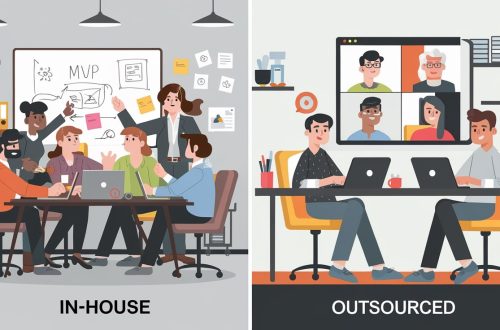
Every founder faces a pivotal decision: should you build your MVP yourself, hire freelancers, or work with a professional MVP development service? The answer isn’t always obvious, and getting it wrong can cost you months of progress and thousands of dollars.
Some startups genuinely benefit from bootstrapping their own development. But for many founders, trying to build in-house when they should have hired professionals leads to delayed launches, bloated budgets, and products that miss the mark. The key is knowing which category you fall into.
In this guide, we’ll explore the telltale signs that your startup needs professional MVP development services. If you recognize yourself in three or more of these signs, it’s time to seriously consider bringing in expert help.
Sign #1: You’re a Non-Technical Founder
The most obvious sign, but worth stating clearly: if you don’t have software development skills, you need someone who does. The question is whether that someone should be a freelancer, an in-house hire, or a professional service.
Non-technical founders often underestimate what “building an app” actually involves. It’s not just coding—it’s architecture decisions, database design, security implementation, deployment configuration, and ongoing maintenance. Each of these requires specialized knowledge that takes years to develop.
According to CB Insights research, 23% of startups fail because they don’t have the right team. For non-technical founders, this often means lacking the technical expertise to execute their vision effectively.
Professional MVP development services solve this by providing an entire team—designers, developers, architects, and project managers—with the combined experience of dozens of startup builds. You get the benefit of that expertise without the overhead of hiring full-time employees.
What to Consider
If you’re non-technical, you have three main options: learn to code yourself (time-consuming), find a technical co-founder (hard to find), or hire professional help (fastest path to launch). For most founders focused on business development and fundraising, the third option makes the most sense.
Sign #2: Your Timeline Is Tight
Speed matters in the startup world. Maybe you’re racing to beat a competitor to market. Perhaps you have a funding deadline that requires a working prototype. Or you might need to validate your idea before your runway runs out.
When time is critical, professional MVP development services offer a significant advantage: they’ve built this before. While you’d be figuring out best practices through trial and error, an experienced team follows proven processes that compress development time.
As we explored in our article on how MVP services save startups money, professional teams often deliver in weeks what would take inexperienced developers months. That time savings can be the difference between launching successfully and missing your market window.
Consider the math: if you hire a junior freelancer at a lower hourly rate but the project takes 3x longer, you haven’t saved money—you’ve spent more while also losing time you can never get back.
Sign #3: You’ve Already Tried DIY and It’s Not Working
Many founders try the DIY route first. They use no-code tools, hire a cheap freelancer from a marketplace, or convince a friend to help build their MVP. Sometimes this works. But often, it leads to frustrating outcomes:
- The no-code tool hits limitations that require custom development anyway
- The freelancer disappears mid-project or delivers subpar work
- The friend gets busy with their day job and progress stalls
- The codebase becomes a mess that’s hard to maintain or scale
If you’ve already experienced one of these scenarios, you know how demoralizing it is. You’ve spent money, time, and emotional energy, and you’re back at square one—sometimes with technical debt that makes the next attempt even harder.
Professional MVP development services exist specifically to avoid these problems. They have contracts, accountability structures, and reputations to protect. When you hire a professional service, you’re not just buying development hours—you’re buying reliability and peace of mind.
Sign #4: Your MVP Requires Complex Features
Not all MVPs are created equal. A simple landing page with an email signup is very different from a marketplace with payments, messaging, and user authentication. The more complex your core features, the more you need professional expertise.
Features that typically require professional development include:
- Payment processing: Stripe, PayPal, or in-app purchases require careful implementation to handle edge cases and security requirements.
- Real-time functionality: Chat, notifications, or live updates require specialized architecture.
- AI/ML integration: Chatbots, recommendations, or data analysis need expertise in AI tooling and APIs.
- Multi-platform support: Building for web, iOS, and Android simultaneously multiplies complexity.
- Third-party integrations: CRM systems, analytics platforms, or industry-specific APIs often have quirks that experienced developers know how to handle.
If your MVP includes multiple items from this list, you’re dealing with a level of complexity that benefits significantly from professional development experience. These aren’t features you want to learn on while building your first product.
Sign #5: You Need to Raise Funding
Investors evaluate startups not just on ideas but on execution capability. A polished, functional MVP demonstrates that you can ship product—which is one of the most important signals early-stage investors look for.
Professional MVP development services help you put your best foot forward. They create products that look and feel professional, not like student projects. This matters more than many founders realize. When an investor tests your MVP on their phone, every bug, every slow load time, every confusing interface creates doubt about your team’s capabilities.
Moreover, experienced development partners understand what investors look for. They can help you prioritize features that demonstrate traction potential and avoid over-engineering that burns through your pre-funding budget.
As noted by Y Combinator, investors want to see that you can execute. A well-built MVP from a professional team signals that you know how to get things done—even if you’re not personally writing the code.
Sign #6: You’ve Hired Developers But Lack Technical Leadership
Some founders hire developers directly—either freelancers or junior full-time employees—without having technical leadership to guide them. This often leads to problems: developers make architectural decisions that create technical debt, work without clear priorities, or build features that don’t align with business goals.
Professional MVP development services include technical leadership as part of the package. You get senior architects who make smart technology choices, project managers who keep work on track, and experienced developers who write maintainable code. This guidance is especially valuable for our article on what’s included in professional MVP services.
If you’ve hired developers but find yourself frustrated by slow progress, scope creep, or quality issues, the problem often isn’t the developers—it’s the lack of experienced technical leadership. A professional service fills this gap.
Sign #7: You Need to Scale Your Development Quickly
Sometimes opportunity strikes fast. You get accepted into an accelerator, close an unexpected funding round, or land a big customer who needs features delivered on a tight timeline. Suddenly, you need to scale your development capacity—but hiring takes months.
Professional MVP development services can scale up quickly because they already have teams in place. Adding another developer or designer to your project is a matter of days, not the weeks or months required to recruit, interview, and onboard new employees.
This flexibility is particularly valuable in the startup world, where opportunities are time-sensitive and plans change frequently. You can ramp up development when you need to push hard and scale back when you’re in a validation phase.
Sign #8: Quality and Security Are Non-Negotiable
Some industries—healthcare, finance, enterprise software—require higher quality and security standards from day one. You can’t launch a healthcare app with security vulnerabilities or a finance app that occasionally loses transactions. The consequences are too severe.
Professional MVP development services bring established quality assurance processes: code reviews, automated testing, security audits, and compliance expertise. They’ve built products in regulated industries before and know what “good enough for launch” looks like in these contexts.
Even outside regulated industries, quality matters. As we discussed in our guide on creating an MVP for your startup, your MVP is a reflection of your brand. A buggy, insecure product damages your reputation with early users—the very people you need to become advocates.
Sign #9: You Value Your Time for Business Development
Every hour you spend managing developers, debugging code, or learning deployment tools is an hour you’re not spending on customers, investors, marketing, or strategy. For many founders, this trade-off doesn’t make sense.
Consider your unique value as a founder. Is it your technical skills, or is it your vision, domain expertise, customer relationships, or fundraising ability? If it’s the latter, your time is better spent on those high-leverage activities while professionals handle the development.
Professional MVP development services minimize the management burden on founders. You provide input on features and priorities, review progress, and give feedback—but you’re not deep in the weeds of sprint planning, code reviews, or deployment pipelines. That’s what you’re paying for.
Sign #10: You Want to Own Your Code and IP
A common concern with hiring any outside help is intellectual property. Who owns the code? Can you take it to another developer if the relationship doesn’t work out?
Reputable professional MVP development services transfer all code and IP to you upon completion. You own everything—source code, designs, documentation—and can take it to any developer in the future. Fundamentally different from some no-code platforms that lock you into their ecosystem.
When evaluating services, always confirm IP ownership is spelled out clearly in the contract. Any professional service will have standard terms that protect your ownership. If they’re reluctant to discuss this, consider it a red flag.
How Many Signs Apply to You?
Take a moment to count how many of these signs resonate with your situation:
- You’re a non-technical founder
- Your timeline is tight
- DIY attempts haven’t worked
- Your MVP requires complex features
- You need to raise funding
- You have developers but lack technical leadership
- You need to scale development quickly
- Quality and security are non-negotiable
- Your time is better spent on business development
- You want to own your code and IP
If three or more of these apply, professional MVP development services are likely the right choice for your startup. The investment will save you time, reduce risk, and improve your chances of launching a successful product.
If you’re considering hiring an MVP developer, our sister site has a detailed guide on how to hire an MVP developer that can help you evaluate your options.
Conclusion: Know When to Ask for Help
There’s no shame in hiring professionals. The most successful founders know their strengths and build teams to complement them. If your strength is vision, sales, domain expertise, or fundraising—not software development—then partnering with professional MVP development services lets you focus on what you do best.
The signs we’ve covered aren’t weaknesses; they’re data points that help you make a smart decision about resource allocation. Building in-house makes sense for some startups. But for many, professional development services offer a faster, more reliable, and ultimately more cost-effective path to a validated MVP.
Recognize where you are, be honest about your capabilities and constraints, and choose the path that gives your startup the best chance of success.
Have questions about whether professional MVP development is right for your startup? Drop a comment below—we read and respond to every one.