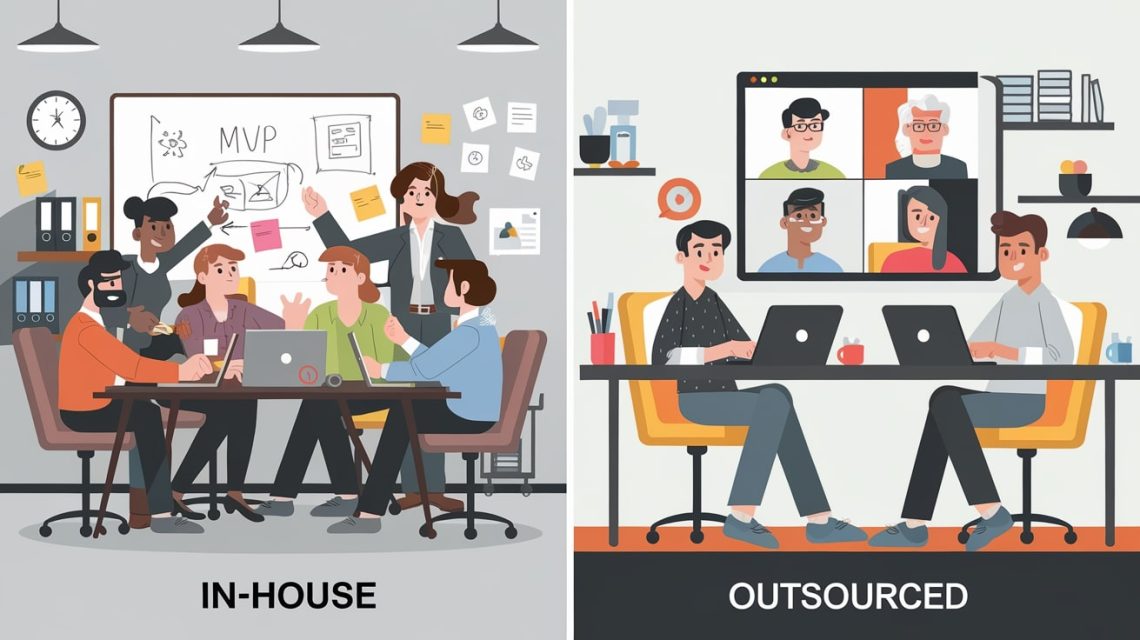
The honest comparison every founder needs before deciding how to build their MVP.
You’ve validated your idea. You know what you want to build. Now comes the big question: should you build your MVP in-house or outsource it to an external team?
This decision will impact your budget, timeline, product quality, and ultimately your startup’s chances of success. Get it right, and you’ll launch faster with a better product. Get it wrong, and you could waste months and tens of thousands of dollars.
Let’s break down the real pros and cons of each approach—with honest numbers and practical guidance for making the right choice.
Understanding Your Options
Before comparing, let’s define what we’re actually talking about:
In-House Development
Hiring full-time employees or using your own technical skills to build the MVP. This includes:
- Hiring full-time developers
- Using a technical co-founder’s skills
- Building it yourself (if you’re technical)
Outsourced Development
Hiring external resources to build your MVP. This includes:
- Freelance developers
- Development agencies
- Specialized MVP development services
- Offshore development teams
As we covered in our complete guide to MVP development services, there are multiple outsourcing options—each with different trade-offs.
The Complete Comparison
Cost Comparison
Let’s look at real numbers:
| Approach | Upfront Cost | Monthly Ongoing | Year 1 Total |
|---|---|---|---|
| In-House (1 developer) | $5K-$15K (recruiting) | $8K-$15K salary + benefits | $100K-$200K+ |
| Freelancer | $5K-$20K (project) | $0-$2K (maintenance) | $5K-$30K |
| MVP Agency | $5K-$25K (project) | $0-$3K (support) | $5K-$40K |
| Offshore Team | $3K-$15K (project) | $2K-$8K (retainer) | $25K-$110K |
The verdict: Outsourcing typically costs 50-80% less for MVP development. In-house only makes financial sense if you need continuous development for 12+ months.
Timeline Comparison
| Approach | Time to Start | MVP Delivery | Total Timeline |
|---|---|---|---|
| In-House Hire | 4-12 weeks (hiring) | 8-16 weeks (development) | 3-7 months |
| Freelancer | 1-3 weeks (finding) | 4-12 weeks | 5-15 weeks |
| MVP Agency | 1-2 weeks (onboarding) | 2-6 weeks | 3-8 weeks |
| Offshore Team | 2-4 weeks (setup) | 6-12 weeks | 8-16 weeks |
The verdict: If speed matters (and for startups, it usually does), outsourcing to an experienced agency is typically 2-3x faster than building an in-house team.
In-House Development: Deep Dive
Pros of Building In-House
1. Full Control and Alignment
Your team is fully dedicated to your vision. They attend every meeting, understand every nuance, and care about your success because their job depends on it.
2. Institutional Knowledge
Everything learned stays in-house. No knowledge transfer needed, no documentation gaps. Your developers understand why decisions were made.
3. Faster Iteration Post-MVP
Once your team is in place, making changes and adding features becomes seamless. No new contracts, no onboarding—just build.
4. Culture and Values
In-house developers become part of your company culture. They’re invested in the mission, not just the paycheck.
5. Long-Term Cost Efficiency
If you need continuous development for years, in-house eventually becomes more cost-effective than perpetual outsourcing.
Cons of Building In-House
1. Slow to Start
According to Deloitte research, the average time to hire a skilled developer is 6-12 weeks—and that’s after you’ve started looking. Most startups can’t afford this delay.
2. High Fixed Costs
Salaries, benefits, equipment, office space (if applicable), and management overhead add up. You’re paying the same amount whether there’s work or not.
3. Hiring Risk
What if you hire the wrong person? It happens frequently. Now you’ve lost months and need to start over.
4. Single Point of Failure
With one or two developers, illness, vacation, or resignation can halt your entire project.
5. Limited Expertise
One developer can’t be expert in everything. You might need frontend, backend, DevOps, and design—that’s multiple hires.
Outsourced Development: Deep Dive
Pros of Outsourcing
1. Speed to Market
Established agencies and freelancers can start immediately. No hiring process, no onboarding—just kick off the project.
2. Access to Diverse Expertise
Agencies bring full teams: designers, frontend developers, backend developers, QA testers. You get all the skills you need without multiple hires.
3. Predictable Costs
Fixed-price projects mean you know exactly what you’ll spend. No surprise salary negotiations or benefits costs.
4. Lower Risk
If a relationship isn’t working, you can end it. No severance, no legal complications, no awkward conversations.
5. Proven Process
Good agencies have built dozens or hundreds of MVPs. They’ve solved problems you don’t even know exist yet.
Cons of Outsourcing
1. Less Control
External teams have other clients. You’re not their only priority, even if you’re paying well.
2. Communication Overhead
Explaining your vision takes time. Misunderstandings happen. Time zones can complicate collaboration.
3. Knowledge Leaves With Them
When the project ends, institutional knowledge walks out the door. Documentation helps but doesn’t replace having someone who was there.
4. Quality Variance
The outsourcing market varies wildly in quality. Finding good partners requires due diligence.
5. Long-Term Cost
If you need continuous development for years, outsourcing fees can exceed in-house costs over time.
Decision Framework: Which Is Right for You?
Choose In-House Development If:
- ✅ You have a technical co-founder who can build the MVP
- ✅ You have 18+ months of runway
- ✅ You’re building a tech-first company where code is your core competency
- ✅ You can wait 3-6 months to launch
- ✅ You plan to iterate continuously for years
- ✅ You have experience managing technical teams
Choose Outsourced Development If:
- ✅ You’re non-technical and need guidance
- ✅ Speed to market is critical
- ✅ You have limited runway (under 12 months)
- ✅ You’re validating an idea before committing long-term
- ✅ Your MVP is well-defined with clear scope
- ✅ You want predictable, fixed costs
The Hybrid Approach
Many successful startups use a hybrid approach:
Phase 1: Outsource the MVP
Get to market quickly with an external team. Validate your product-market fit without the overhead of full-time employees.
Phase 2: Build In-House for Scale
Once validated, hire a core team to take over and iterate. They inherit a working product instead of starting from scratch.
This approach gives you the best of both worlds: startup speed for validation, then in-house control for scaling.
Outsourcing Options Compared
If you decide to outsource, you have several options. Here’s how to choose:
Freelancers
Best for: Small, well-defined projects; tight budgets; technical founders who can manage
Pros: Lower rates, flexible engagement, direct communication
Cons: Single point of failure, you manage the project, quality varies widely
If you go this route, learn how to hire an MVP developer properly to avoid common mistakes.
MVP Development Agencies
Best for: Non-technical founders; time-sensitive projects; full-service needs
Pros: Full team, proven process, project management included, fixed pricing
Cons: Higher cost than freelancers, less flexibility mid-project
Offshore Development Teams
Best for: Cost-conscious projects; technical founders who can manage; ongoing development
Pros: Lower rates, scalable team size, extended hours coverage
Cons: Communication challenges, time zone issues, cultural differences, quality variance
What About Technical Co-Founders?
The best-case scenario for in-house development is having a technical co-founder. But finding one is notoriously difficult.
If you’re searching for a technical co-founder, consider these alternatives:
- Outsource first, then find a co-founder: It’s easier to attract technical talent when you have a working product and traction.
- Advisor + outsourcing: Find a technical advisor to guide decisions while outsourcing the actual building.
- Learn enough to manage: You don’t need to code, but understanding basics helps you manage external teams.
For a complete walkthrough of the development process, check out our guide on startup MVP development.
Common Mistakes to Avoid
❌ Hiring Too Early
Building a team before you’ve validated your idea means paying salaries while you’re still figuring out what to build. Outsource first, hire later.
❌ Choosing Based on Cost Alone
The cheapest option is rarely the best value. A $3,000 MVP that doesn’t work costs more than a $10,000 MVP that launches successfully.
❌ Underestimating Management Overhead
Both in-house and outsourced teams need management. If you’re non-technical, this overhead is higher with freelancers than with full-service agencies.
❌ Ignoring Cultural Fit
Whether hiring or outsourcing, working style matters. A brilliant developer who doesn’t communicate well will cause problems.
❌ Not Planning for Post-MVP
Your MVP is just the beginning. Consider who will maintain and iterate on the product after launch.
Making the Transition
If you start with outsourcing and want to move in-house later:
Before the Project Ends:
- Request full documentation
- Schedule knowledge transfer sessions
- Get access to all accounts and credentials
- Ensure clean, well-commented code
- Have them onboard your new hire before leaving
When Hiring Your First Developer:
- Look for someone who can work with existing codebases
- Prioritize communication skills alongside technical ability
- Consider hiring the freelancer/agency member if they’re available
Real-World Scenarios
Scenario 1: The Solo Non-Technical Founder
Situation: Sarah has a SaaS idea, $30K saved, and no coding experience.
Recommendation: Outsource to an MVP agency. She gets expertise, speed, and fixed costs—important when every dollar counts.
Scenario 2: The Funded Startup
Situation: Alex raised a $500K seed round and needs to build fast.
Recommendation: Hybrid approach. Outsource the MVP for speed, then hire 1-2 senior developers to take over post-launch.
Scenario 3: The Technical Founder
Situation: Jordan is a senior developer with an idea.
Recommendation: Build in-house (themselves). They can move faster alone than coordinating with others, and they understand what they’re building.
Scenario 4: The Bootstrapped Marketplace
Situation: Mike wants to build an MVP website for a local services marketplace with minimal budget.
Recommendation: Start with no-code tools for validation, then outsource to a freelancer for custom features once validated.
Key Questions to Ask Yourself
Before deciding, answer honestly:
- How urgent is launching? (High urgency = outsource)
- What’s your runway? (Short runway = outsource)
- How technical are you? (Non-technical = agency over freelancer)
- Is this idea validated? (Unvalidated = outsource to minimize risk)
- How long will you need developers? (Under 12 months = outsource)
- What’s your budget? (Under $50K first year = outsource)
If most answers point to outsourcing, that’s probably the right choice for your MVP. Teams like BuildMVPApp specialize in fast, fixed-price MVP builds for startups.
Frequently Asked Questions
Can I switch from outsourced to in-house later?
Yes, and many startups do exactly this. The key is ensuring good documentation and a clean handoff. Plan for 2-4 weeks of transition time when your new hire overlaps with the outgoing team.
How do I find reliable outsourcing partners?
Check portfolios for similar projects, contact references, start with a small paid test project, and look for clear communication during the sales process. Red flags include vague pricing, no portfolio, and pressure to sign quickly.
What if I need changes after the outsourced project ends?
Most agencies offer ongoing support packages or hourly maintenance. Alternatively, you can hire a freelancer for updates or bring someone in-house. Having clean, documented code makes this easier.
Is offshore outsourcing worth the cost savings?
It can be, but proceed carefully. Time zone differences and communication challenges often offset cost savings. It works best when you have technical expertise to manage the relationship and clear, detailed requirements.
Should I give equity to outsourced developers?
Generally no. Pay fair market rates and keep equity for employees who will be with you long-term. If an outsourced developer becomes indispensable, consider hiring them with an equity package.
Still deciding between in-house and outsourced development? Share your situation in the comments—we help founders think through this decision every day.